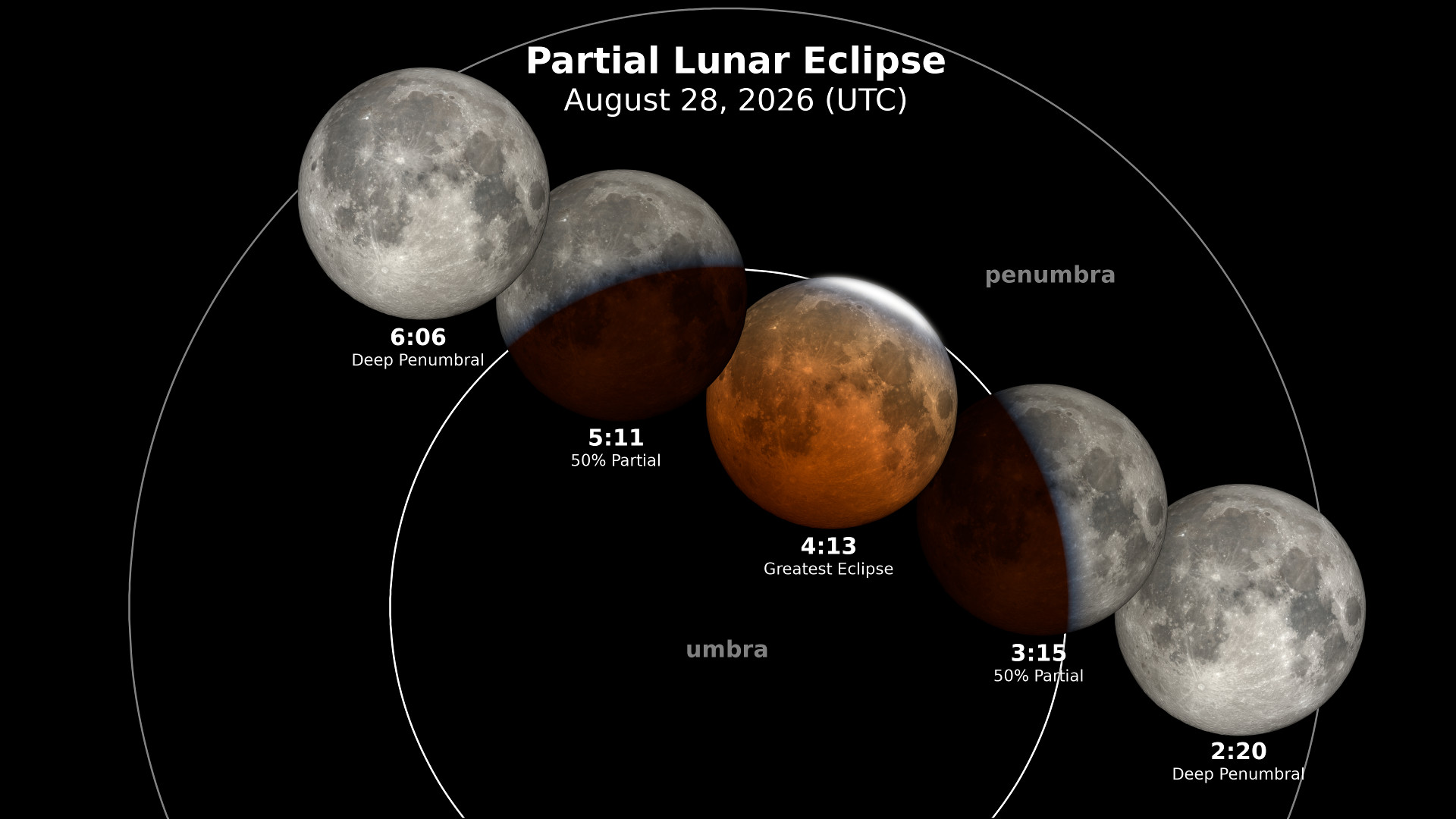

A near-total lunar eclipse occurs tonight, August 27–28, 2026, with the moon reaching 96.2% coverage — the deepest lunar eclipse of the year. The eclipse peaks at approximately 9:12 PM Pacific / 10:12 PM Mountain / 11:12 PM Central / 12:12 AM Eastern, turning the moon a dramatic deep red-orange “Blood Moon” color visible to the naked eye across North and South America, Europe, and Africa. No special equipment is needed. Track the moon live on the Moon Phase Clock.
What's Happening Tonight
Earth passes almost entirely between the sun and the moon tonight, casting its shadow across 96.2% of the lunar surface. At peak eclipse, only a thin sliver of the moon's southern edge remains in direct sunlight — the rest glows deep red-orange as filtered light from every sunrise and sunset on Earth simultaneously reaches the lunar surface.
This is the deepest lunar eclipse of 2026 and one of the most visually striking lunar events of the year. A total eclipse covers 100% of the moon; tonight's 96.2% coverage produces nearly the same dramatic color transformation, with a faint bright edge along one limb that makes the geometry of the event especially visible.
Peak Times by US Timezone
The eclipse unfolds over several hours as the moon slowly enters, crosses, and exits Earth's shadow. The deepest phase — when the Blood Moon color is most intense — lasts roughly one hour centered on these peak times:
- Pacific: 9:12 PM Thursday, August 27
- Mountain: 10:12 PM Thursday, August 27
- Central: 11:12 PM Thursday, August 27
- Eastern: 12:12 AM Friday, August 28
The partial phases begin approximately one to two hours before peak and continue one to two hours after, so the eclipse is visible for a wide window around these times. For live tracking and your exact local moonrise time, visit the Moon Phase Clock.
How to Watch
A lunar eclipse is completely safe to observe with the naked eye — no special glasses or filters are needed. Unlike a solar eclipse, the light involved is reflected moonlight passing through Earth's shadow, which poses no risk to eyesight.
Look southeast after dark. The moon rises in the east and tracks across the southern sky. By the time the deepest phase begins, the moon is well above the horizon in most of the Americas. The higher the moon, the clearer the view — less atmosphere between the observer and the moon means sharper color and contrast.
Get away from city lights. The eclipse is visible from anywhere the moon is above the horizon, but darker skies reveal the Blood Moon color more vividly. A park, rooftop, or any spot away from direct streetlights makes a noticeable difference. Binoculars enhance the view but are not required.
Why the Moon Turns Red
During a lunar eclipse, the moon passes into Earth's shadow — but it does not go completely dark. Earth's atmosphere acts as a lens, bending sunlight around the planet's edge and projecting it onto the lunar surface. As the light passes through the atmosphere, short-wavelength blue light is scattered away by the same process — Rayleigh scattering — that makes the daytime sky blue and sunsets red.
The remaining long-wavelength red and orange light continues through and reaches the moon, bathing it in the combined glow of every sunrise and sunset happening around Earth's rim at that moment. The exact shade varies from eclipse to eclipse depending on atmospheric conditions — volcanic eruptions, wildfire smoke, and cloud cover along Earth's limb all affect the color, ranging from bright copper-orange to deep brick red.
How Long Does It Last
The full eclipse sequence — from the first faint darkening as the moon enters the penumbral shadow, through the deep red-orange peak, and back out — spans several hours. The visually dramatic portion, when the moon is noticeably darkened and colored, lasts roughly two to three hours total, with the deepest Blood Moon phase concentrated in about one hour around peak.
Casual observers who step outside within an hour of the peak times listed above will see the eclipse at or near its most dramatic. There is no need to catch the exact moment — the color change develops gradually and is striking throughout the deep phase.
Where It's Visible
Tonight's eclipse is visible from any location where the moon is above the horizon during the eclipse window. That includes all of North and South America, western and central Europe, and most of Africa. Observers in the western Americas see the eclipse in the evening sky on August 27; those in eastern Europe and Africa see it in the predawn hours of August 28.
For current moon data including phase, illumination, and rise/set times for any location, visit the MoonlightPhase homepage.
Frequently Asked Questions
What time is the lunar eclipse tonight?
Peak eclipse occurs at approximately 9:12 PM Pacific, 10:12 PM Mountain, 11:12 PM Central, and 12:12 AM Eastern on August 27–28, 2026. The visually dramatic phase lasts roughly one hour centered on these times. Track it live on the Moon Phase Clock.
Is it safe to watch a lunar eclipse?
Yes — completely safe with the naked eye. A lunar eclipse involves the moon passing through Earth's shadow, not looking at the sun. No special glasses, filters, or equipment are needed. This is different from a solar eclipse, which does require eye protection.
Why does the moon turn red during an eclipse?
Earth's atmosphere filters sunlight around the planet's edge and onto the lunar surface. Blue light is scattered away (Rayleigh scattering — the same reason sunsets are red), while red and orange light passes through. The moon is illuminated by the combined glow of every sunrise and sunset on Earth at once, producing the “Blood Moon” color.
Where is the eclipse visible?
The August 27–28, 2026 lunar eclipse is visible across North and South America, Europe, and Africa — anywhere the moon is above the horizon during the eclipse window. No travel is required for observers in these regions.