What Is the Hunter's Moon?

Plan 2027 by the Moon
Get the Calendar · $9.99 →Quick Answer
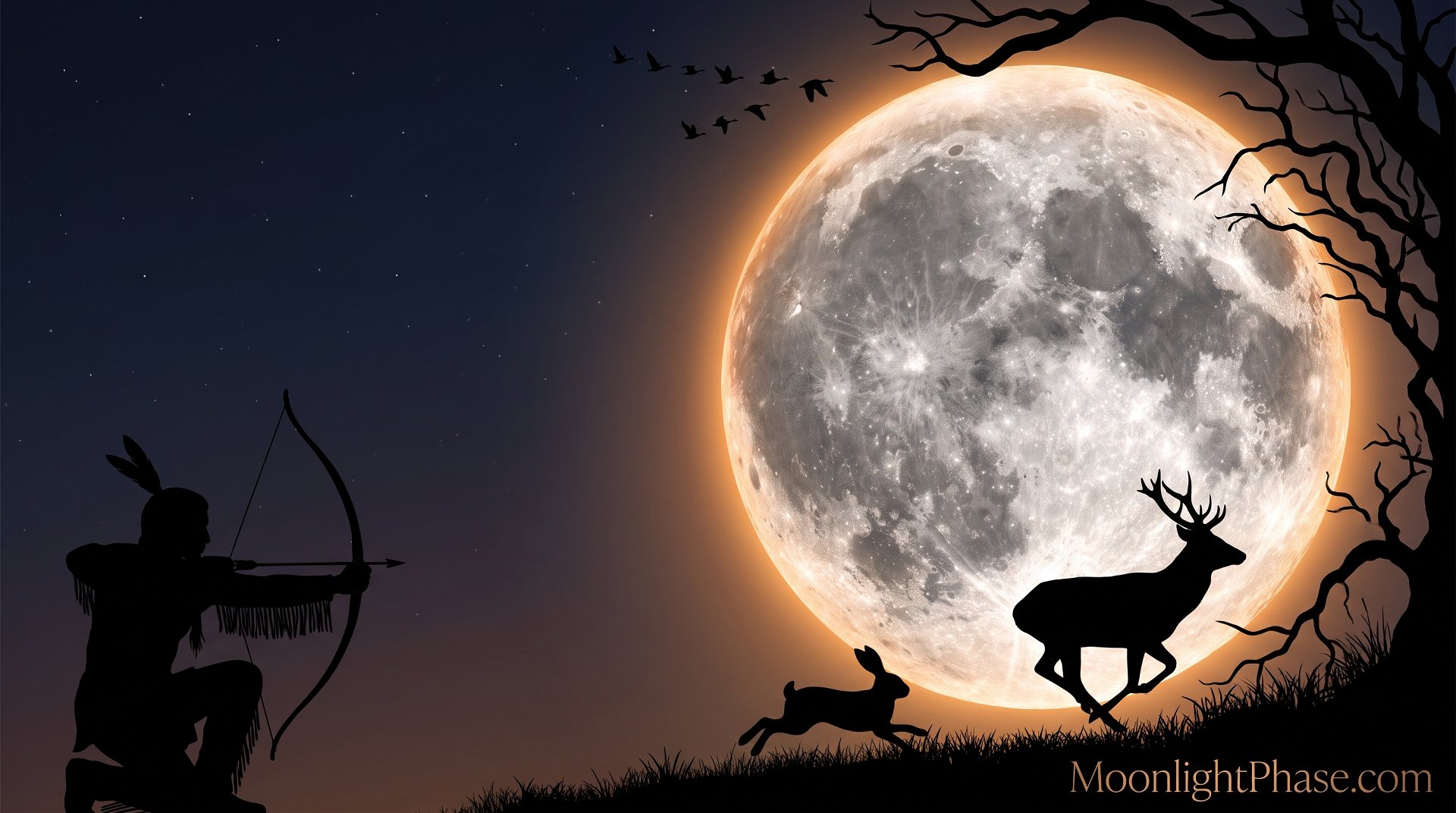
The Hunter's Moon is the full moon that follows the Harvest Moon — typically October's full moon in the Northern Hemisphere, occasionally shifting to November. Like the Harvest Moon, it rises only 20–30 minutes later each night instead of the usual 50, flooding the autumn landscape with light. The name comes from Indigenous North American and Colonial American tradition: with the summer harvest cleared, deer and other game were easier to spot across open fields in the moon's bright glow, giving hunters an extended window to stock meat for the coming winter.
Origin of the Name: Light for the Hunt
The name Hunter's Moon traces back to the same farming-almanac tradition that produced most of the familiar full moon names. By October, the harvest was in, fields were cleared of standing crops, and deer, elk, foxes, and other game had grown fat on the autumn's bounty — making them both easier to spot and more valuable to take before winter.
The Hunter's Moon rose shortly after sunset for several consecutive evenings, bathing the open fields and bare forests in silver light. For Indigenous hunters across the northeastern woodlands, and later for European settlers who adopted the name, this stretch of bright moonlit evenings was the practical window to lay in meat for the cold months ahead.
The name appears across Algonquin, Anishinaabe, and other Native American naming traditions, as well as in the Old Farmer’s Almanac and British folklore. Unlike the Harvest Moon — which crossed cultures because every farming community recognized its utility — the Hunter’s Moon carries a specifically hunting-season identity rooted in autumn woodland culture.
The Astronomy of the Hunter's Moon
The Hunter's Moon shares the Harvest Moon's signature feature: a compressed moonrise delay. On most nights of the year, moonrise shifts about 50 minutes later from one evening to the next. In October, that delay stays unusually short — typically 25 to 40 minutes at mid-northern latitudes — producing several consecutive evenings of bright, early-rising moonlight.
The cause is the same geometry that produces the Harvest Moon effect. In autumn, the moon's orbital path (the ecliptic) meets the eastern horizon at a shallow angle in the evening sky. The moon does not need to travel as far along its orbit to clear the horizon on successive nights, so moonrise shifts only slightly later each evening. The effect persists through October, giving the Hunter's Moon its own run of unusually bright evenings.
At higher latitudes — Scotland, Scandinavia, Canada — the effect is even more pronounced. Closer to the equator, seasonal changes in the ecliptic angle are smaller, and the compressed moonrise effect fades.
When Does the Hunter's Moon Occur?
The Hunter's Moon is traditionally defined as the full moon that follows the Harvest Moon. In most years, this places it in October. In the roughly one-in-three years when the Harvest Moon shifts to October (because the October full moon falls closer to the autumn equinox than September's), the Hunter's Moon then shifts to November.
This back-and-forth relationship with the Harvest Moon is what makes the Hunter's Moon the second-most-flexible name in the traditional calendar — only the Harvest Moon itself is more variable. For 2026, the Harvest Moon falls on September 26 and the Hunter's Moon follows on October 26, 2026.
How to Observe the Hunter's Moon
The Hunter's Moon is one of the easiest full moons to catch at its most striking. Like the Harvest Moon, it rises shortly after sunset — often appearing in the eastern sky while the western horizon still glows orange with dusk. The low altitude plus the thick, dust-rich autumn air give the moon a deep amber or copper tone that photographers prize.
The warm color is the same atmospheric scattering that reddens sunsets: moonlight traveling through more of Earth's atmosphere loses its blue wavelengths and takes on red and orange hues. As the moon climbs higher through the night, it fades to its usual silver-white.
The apparent largeness of the Hunter's Moon near the horizon is the Moon Illusion — a perceptual effect in which the brain judges the moon as larger when framed against trees, buildings, and horizon features. The moon's angular size does not actually change.
- Watch at moonrise — the first 20–30 minutes after sunset give the deepest color
- Look east as the sun sets; the Hunter's Moon rises almost directly opposite the sun
- Open rural fields, lakeshores, and east-facing hilltops give the most dramatic view
- No equipment needed — the Hunter's Moon is bright enough to cast shadows
- Return the next two or three evenings to see the unusually short moonrise delay in action
- Clear, crisp autumn air often gives October's full moon exceptional sharpness
Hunter's Moon vs. Harvest Moon
The Hunter's Moon and the Harvest Moon are sibling events, back-to-back full moons that share the same astronomical signature: compressed moonrise delay thanks to the shallow autumn ecliptic. They differ only in cultural emphasis.
The Harvest Moon marks the final push to bring in crops — a farmer's moon. The Hunter's Moon marks the shift from farming season to hunting season, when stored grain was secured and the focus turned to meat for winter. Together they bookend the autumn transition from growing season to cold-weather survival.
Because the two moons are consecutive, you can see the full seasonal arc in just two months — late September's warm fields giving way to late October's bare branches and frost, both lit by moons that rise early and linger near the horizon.
Cultural and Historical Significance
The Hunter's Moon carries strong Indigenous North American roots. Algonquin, Anishinaabe, Cree, and other peoples of the eastern woodlands recognized October as the month to lay in winter meat, and the full moon's extended light made that work possible after the short autumn days ended.
In Colonial America, European settlers adopted the name alongside Indigenous teachers who taught them which plants and animals to track in each season. By the 19th century, Hunter's Moon had become standard almanac vocabulary — the first full moon after Harvest — and it remained one of the most familiar full-moon names in American English.
In modern popular culture, the Hunter's Moon features in literature, film, and music as shorthand for autumn, mystery, and the turning of the year. Its rich amber glow and association with the end of the growing season make it one of the most photographed and romanticized full moons of the year.
Use Our Tools
Frequently Asked Questions
Why is it called the Hunter's Moon?
The Hunter's Moon takes its name from the autumn hunting season. With fields cleared after the harvest, deer and other game were easier to spot and track across open ground, and the moon's bright early-evening light extended the hunting day well into the night. The name comes from Indigenous North American and Colonial American tradition and marks the shift from farming season to the push for winter meat.
When is the Hunter's Moon in 2026?
The 2026 Hunter's Moon falls on Monday, October 26, 2026 — the full moon that follows September 26's Harvest Moon. It rises in the east shortly after local sunset. Check the Full Moon Calendar for the exact time at your location.
Is the Hunter's Moon always in October?
Usually, but not always. The Hunter's Moon is defined as the full moon that follows the Harvest Moon. In most years the Harvest Moon falls in September and the Hunter's Moon in October. In the roughly one-in-three years when the Harvest Moon shifts to October, the Hunter's Moon shifts to November.
Why does the Hunter's Moon look so orange?
Like the Harvest Moon, the Hunter's Moon spends more time near the horizon on consecutive evenings. Low on the horizon, moonlight passes through more of Earth's atmosphere, which scatters blue wavelengths and lets red and orange through — the same process that reddens sunsets. The color fades to white as the moon climbs higher in the sky.
What is the difference between the Harvest Moon and the Hunter's Moon?
They are consecutive full moons that share the same astronomy — compressed moonrise delay thanks to the shallow autumn ecliptic — but mark different seasonal activities. The Harvest Moon lit farmers' late-evening work to bring in crops. The Hunter's Moon lit the hunting season that followed, when cleared fields and fattened game made it the right time to secure meat for winter.
Related Guides
More Moon Guides
All guides →Loading live moon data…